

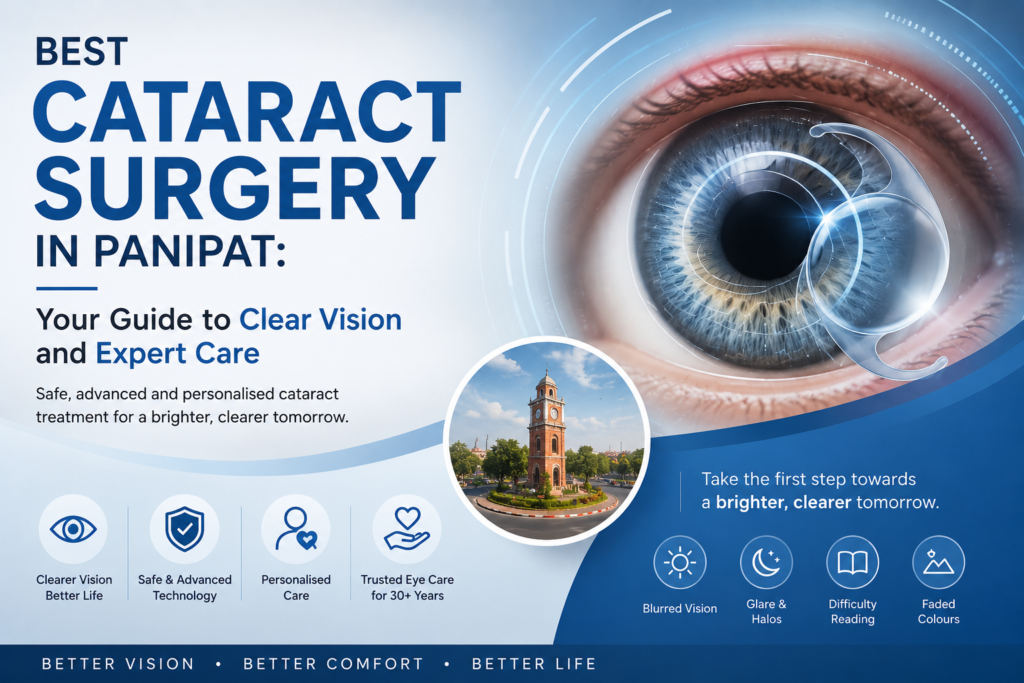
Cataracts are one of the most common causes of blurred vision in adults, and for most people, they are also one of the most treatable eye conditions. If you or a loved one has been struggling with cloudy vision, glare while driving, or difficulty reading in normal light, it may be time to consider cataract surgery. For patients across Panipat and the surrounding areas, Bajaj Eye Centre has been a trusted name in eye care for over three decades, offering safe, modern, and personalised cataract treatment close to home.
This guide walks you through everything you need to know about cataract surgery — what a cataract is, how it develops, when surgery becomes necessary, how the procedure works, and why Bajaj Eye Centre continues to be regarded as the destination for the best cataract surgery in Panipat.
What Is a Cataract?
The eye’s natural lens sits behind the iris and pupil and is responsible for focusing light onto the retina, allowing you to see clearly. A cataract develops when the proteins in this lens begin to clump together, causing the lens to become cloudy over time. As the clouding progresses, less light is able to pass through, and vision gradually becomes blurred, hazy, or dull.
Cataracts usually develop slowly and painlessly, which is why many people do not notice the change until it starts affecting everyday activities like reading, driving, or recognising faces. Left untreated, a cataract can eventually lead to significant vision loss, making early recognition and timely treatment important for preserving eyesight and independence.
Common Causes of Cataracts
While ageing is the leading cause of cataracts, several other factors can contribute to their development, sometimes even at a younger age:
- Age-related changes – The natural breakdown of lens proteins over time is the most frequent cause, typically becoming noticeable after the age of 50.
- Diabetes – Poorly controlled blood sugar levels can accelerate lens clouding.
- Prolonged UV exposure – Years of unprotected sun exposure can damage the lens.
- Smoking and excessive alcohol use – Both increase oxidative stress on the eyes.
- Previous eye injury or surgery – Trauma to the eye can trigger early cataract formation.
- Long-term steroid use – Certain medications are known to increase cataract risk.
- Family history – A genetic predisposition can make some individuals more likely to develop cataracts earlier in life.
Understanding these risk factors helps patients recognise why regular eye check-ups matter, especially after the age of 40.
Explore More About Cataract Care & Healthy Vision
Learn about cataract symptoms, prevention, treatment options, complete eye examinations and other important eye-care topics.
Understanding Cataracts: Causes, Symptoms & Treatment
Explore how cataracts develop, the changes they can cause in vision and when an eye specialist may recommend treatment.
Read Article →Cataract Eye Symptoms in India
Recognise common signs such as cloudy vision, glare, faded colours and difficulty reading or seeing clearly in low light.
Read Article →How to Prevent or Delay Cataract Development
Discover practical eye-care habits and lifestyle measures that may support long-term eye health and healthy vision.
Read Article →Comprehensive Eye Checkup Services in Panipat
Understand why detailed eye examinations are important for detecting cataracts and planning the right treatment at the right time.
Read Article →How Often Should You Get a Retina Scan?
Learn how retinal monitoring supports early detection of eye conditions and helps protect vision over the long term.
Read Article →Discover Expert Eye Care at Bajaj Eye Centre
Explore comprehensive eye-care services designed to support healthy vision through accurate diagnosis and personalised treatment.
Read Article →Signs You May Need Cataract Surgery
Not every cataract requires immediate surgery, but certain symptoms indicate that it is time to consult an eye specialist:
- Blurred, cloudy, or foggy vision that does not improve with a change in glasses
- Increased sensitivity to sunlight or bright indoor lighting
- Difficulty driving at night due to glare or halos around headlights
- Colours appearing faded, dull, or slightly yellow-tinted
- Frequent changes in your eyeglass or contact lens prescription
- Double vision in one eye
- Trouble reading, sewing, or doing close-up tasks even in good light
If these symptoms are starting to interfere with your daily routine, it is a strong sign that a proper eye evaluation — and possibly cataract surgery — should be discussed with your ophthalmologist.
Why Cataract Surgery Is the Only Effective Treatment
Once a cataract has developed, it cannot be reversed with eye drops, exercises, or medication. In the early stages, updated glasses, brighter lighting, or anti-glare lenses may help manage mild symptoms. However, as the cataract matures, the only way to restore clear vision is to surgically remove the clouded lens and replace it with a clear, artificial intraocular lens (IOL).
The good news is that cataract surgery is one of the most refined and commonly performed surgical procedures in modern ophthalmology, with a very high success rate and minimal downtime for most patients.
Modern Cataract Surgery Techniques at Bajaj Eye Centre
Phacoemulsification – The Standard of Modern Cataract Care
Bajaj Eye Centre uses phacoemulsification, the internationally accepted gold-standard technique for cataract removal. In this method, a tiny incision is made in the eye, and an ultrasonic probe is used to gently break the cloudy lens into small fragments, which are then removed through suction. Because the incision is so small, this technique is minimally invasive, typically stitch-free, and allows for a faster visual recovery compared to older surgical methods.
Choosing the Right Intraocular Lens (IOL)
After the natural cloudy lens is removed, it is replaced with an artificial intraocular lens tailored to the patient’s visual needs. Depending on individual lifestyle and eye health, options may include:
- Monofocal lenses – Provide clear vision at one distance, usually for distance vision, with reading glasses used for near tasks.
- Multifocal lenses – Designed to reduce dependence on glasses for both near and distance vision.
- Toric lenses – Specifically designed for patients with astigmatism, correcting both the cataract and the corneal curvature issue in one procedure.
At Bajaj Eye Centre, the ophthalmologist evaluates each patient’s eye health, lifestyle, and visual expectations before recommending the most suitable lens option, ensuring the outcome is personalised rather than one-size-fits-all.
Step-by-Step Cataract Surgery Procedure
Understanding what happens during surgery can ease much of the anxiety patients feel before their appointment.
- Pre-Surgery Evaluation — A detailed eye examination is carried out, including visual acuity testing, measurement of the eye’s curvature and length, and an assessment of overall eye health to plan the correct intraocular lens power.
- Anaesthesia — Cataract surgery is performed under local (topical or local) anaesthesia, meaning the patient remains awake but feels no pain during the procedure.
- Removal of the Cloudy Lens — Using phacoemulsification, the surgeon makes a small incision and gently breaks up and removes the cloudy natural lens.
- Implantation of the Artificial Lens — The pre-selected intraocular lens is carefully placed into the eye, restoring the eye’s ability to focus light properly onto the retina.
- Recovery in the Clinic — The entire procedure typically takes around 15–20 minutes per eye. Most patients rest briefly at the centre before being allowed to go home the same day, as cataract surgery is performed on an outpatient basis.
Why Bajaj Eye Centre Is the Best Choice for Cataract Surgery in Panipat
Decades of Trusted Experience
Founded in 1988 by Dr. R.K. Bajaj and Dr. Vandana Bajaj, Bajaj Eye Centre has been serving the people of Panipat for more than 35 years. This long-standing presence reflects a deep-rooted trust built within the local community across generations of patients.
Experienced Team of Eye Specialists
The team at Bajaj Eye Centre brings extensive clinical experience in cataract diagnosis and surgery, ensuring every patient receives an accurate assessment and a treatment plan suited to their specific eye condition.
Advanced Technology and Quality Standards
Bajaj Eye Centre is committed to maintaining high clinical standards, using modern diagnostic and surgical equipment for cataract evaluation and treatment, so patients receive care aligned with current best practices in ophthalmology.
Comprehensive Eye Care Under One Roof
Beyond cataract surgery, Bajaj Eye Centre offers a full spectrum of eye care services — including glaucoma management, retina care, dry eye treatment, paediatric ophthalmology, and more — allowing patients to receive complete, continuous eye care without being referred elsewhere.
Personalised, Patient-First Approach
Every patient’s eyes and visual needs are different. The team at Bajaj Eye Centre takes the time to explain the diagnosis, discuss lens options, and address every question, ensuring patients feel informed and confident before undergoing surgery.
Recovery After Cataract Surgery
Recovery from cataract surgery is generally quick and comfortable, with most patients noticing improved vision within a few days. To support healing, patients are typically advised to:
- Avoid rubbing or pressing on the operated eye
- Use prescribed eye drops exactly as directed
- Wear protective sunglasses when outdoors
- Avoid swimming, dusty environments, and heavy physical strain for a couple of weeks
- Attend all scheduled follow-up visits so the surgeon can monitor healing
Mild irritation, light sensitivity, or watering in the first few days is common and usually resolves on its own. However, if a patient experiences increasing pain, redness, or sudden vision changes, they should contact their ophthalmologist without delay.
Explore More About Cataract Care & Healthy Vision
Learn about cataract symptoms, prevention, treatment options, complete eye examinations and other important eye-care topics.
Understanding Cataracts: Causes, Symptoms & Treatment
Explore how cataracts develop, the changes they can cause in vision and when an eye specialist may recommend treatment.
Read Article →Cataract Eye Symptoms in India
Recognise common signs such as cloudy vision, glare, faded colours and difficulty reading or seeing clearly in low light.
Read Article →How to Prevent or Delay Cataract Development
Discover practical eye-care habits and lifestyle measures that may support long-term eye health and healthy vision.
Read Article →Comprehensive Eye Checkup Services in Panipat
Understand why detailed eye examinations are important for detecting cataracts and planning the right treatment at the right time.
Read Article →How Often Should You Get a Retina Scan?
Learn how retinal monitoring supports early detection of eye conditions and helps protect vision over the long term.
Read Article →Discover Expert Eye Care at Bajaj Eye Centre
Explore comprehensive eye-care services designed to support healthy vision through accurate diagnosis and personalised treatment.
Read Article →Tips for Long-Term Eye Health After Surgery
- Wear UV-protective sunglasses whenever outdoors, even on cloudy days
- Follow a diet rich in leafy greens, fruits, and antioxidants to support overall eye health
- Keep blood sugar and blood pressure under control if you have diabetes or hypertension
- Avoid smoking, which can affect long-term eye health
- Continue with routine annual eye examinations, even after successful cataract surgery
Frequently Asked Questions About Cataract Surgery
1. How do I know if I need cataract surgery?
If cloudy vision, glare, or difficulty with night driving is affecting your daily activities and cannot be corrected with a new glasses prescription, it is time to consult an ophthalmologist for an evaluation.
2. Is cataract surgery painful?
No. The procedure is performed under local anaesthesia, so patients feel little to no discomfort during surgery.
3. How long does cataract surgery take?
The surgical procedure itself usually takes around 15–20 minutes per eye, and it is performed as a same-day, outpatient procedure.
4. Is cataract surgery safe?
Yes. Cataract surgery is one of the most commonly performed and well-established surgical procedures in ophthalmology, with a very high success rate when performed by an experienced surgical team.
5. How soon can I return to normal activities after surgery?
Many patients resume light daily activities within a day or two, though strenuous activity, swimming, and dusty environments should be avoided for a couple of weeks as advised by the surgeon.
6. Will I still need glasses after cataract surgery?
This depends on the type of intraocular lens chosen. Monofocal lenses may still require reading glasses, while multifocal or toric lenses can reduce dependence on glasses for most activities.
7. Can a cataract come back after surgery?
The cataract itself cannot return, since the natural lens has been replaced. However, some patients may develop a condition called posterior capsule opacification (PCO) months or years later, which can be easily treated with a quick, painless laser procedure.
8. At what age should I start getting regular eye check-ups for cataracts?
It is advisable to begin annual comprehensive eye examinations from the age of 40, or earlier if you have diabetes, a family history of cataracts, or other risk factors.
9. Can both eyes be operated on the same day?
This depends on the surgeon’s clinical assessment. In many cases, eyes are treated in separate sittings a short interval apart to allow proper healing and monitoring of the first eye.
10. Why should I choose Bajaj Eye Centre for cataract surgery in Panipat?
With over three decades of trusted service, an experienced team of eye specialists, modern surgical technology, and a patient-first approach, Bajaj Eye Centre offers comprehensive, reliable cataract care close to home for patients across Panipat.
Conclusion
Cataracts may be a natural part of ageing, but losing your independence to blurred vision does not have to be. With timely diagnosis, modern surgical techniques, and the right care team, cataract surgery can restore clear vision and significantly improve quality of life. If you or a family member is experiencing early signs of cataracts, don’t wait for vision to worsen — schedule a comprehensive eye examination today.
For patients seeking the best cataract surgery in Panipat, Bajaj Eye Centre combines decades of experience, modern technology, and genuine patient care to help you see the world clearly again.
Book Your Cataract Consultation at Bajaj Eye Centre
Address: Bajaj Eye Centre, 206 New Sukhdev Nagar, Panipat
Phone: +91-82959-12777 | 0180-2630777
Follow Us:
Facebook: https://www.facebook.com/bajajeyecentre123
Instagram: https://www.instagram.com/bajajeyecentre/
Twitter: https://twitter.com/Bajajeye_centre
Pinterest: https://in.pinterest.com/bajajeye/