

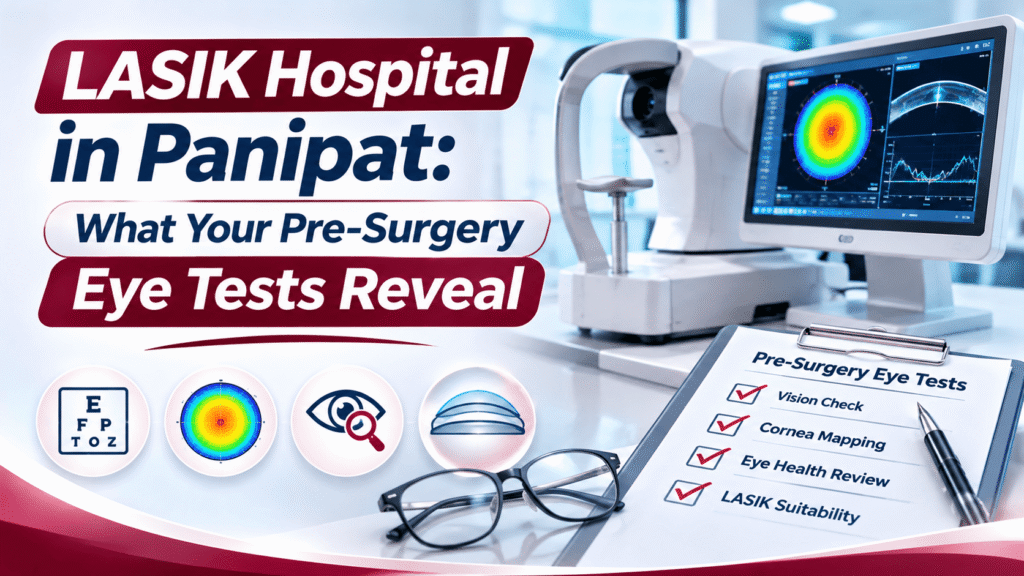
A practical patient guide to eligibility, corneal mapping, dry-eye assessment and preparing for a LASIK consultation
Considering laser vision correction is exciting, but the most important part of the process happens before anyone enters the laser room. The consultation is designed to answer a more useful question than “Can my glasses be removed?” It asks whether your eyes can safely tolerate the planned treatment, which approach might suit them, and what results are realistic for your daily life.
If you are searching for a LASIK Hospital in Panipat, understanding the screening process can help you ask informed questions. Two people with exactly the same spectacle power may receive different recommendations because their corneas, tear film, eye health and visual needs are different. In some cases, the safest plan is to treat an eye condition first, postpone the procedure or choose a non-LASIK option.
At Bajaj Eye Centre, Panipat, the official refractive surgery service information discusses LASIK, PRK, implantable collamer lenses (ICL) and other spectacle-correction approaches for selected patients. This article focuses on what to expect before a decision is made, rather than repeating a general overview of laser platforms and treatment benefits.
Why a LASIK consultation is more than a glasses-power check
A routine refraction determines the lenses that help you see clearly. A preoperative refractive assessment goes further. It examines whether the cornea has sufficient healthy tissue, whether the front surface is regular, whether the prescription is stable and whether other eye conditions could affect comfort or vision. These findings may change the treatment recommendation even when a patient is eager to proceed.
LASIK reshapes corneal tissue with a laser to reduce refractive error. Removing corneal tissue is permanent, so the surgeon must calculate the planned correction and assess the remaining corneal structure. Screening also helps identify patients who may be at higher risk for postoperative dryness or visual symptoms.
A careful consultation should result in an explanation you can understand: what the tests show, whether you qualify, the available alternatives, the limitations and the expected follow-up. It should not end with a decision based on spectacle power or advertising alone.
1. Is your spectacle prescription stable?
One of the first questions is whether your glasses or contact lens power has changed recently. A fluctuating prescription can make it harder to plan a lasting correction. Many refractive surgeons look for stability over approximately a year, although the exact criteria depend on your clinical history, age and procedure.
Bring previous spectacle prescriptions, especially if you have changed glasses during the past 12–24 months. Mention changes noticed during pregnancy, breastfeeding, medication changes or periods of poorly controlled blood sugar, since these can influence refraction. Having a prescription that looks stable on a single day does not always establish long-term stability.
Age alone does not guarantee eligibility. Adults with otherwise healthy eyes can still have an unstable prescription. Similarly, someone over 40 may have age-related near-vision changes despite having stable distance power; these need a separate conversation before surgery.
2. What does corneal topography or tomography show?
The cornea is the transparent front window of the eye. Its shape helps focus incoming light. Corneal topography creates a detailed surface map, while tomography can provide additional information about front and back corneal surfaces and thickness distribution. Your eye doctor determines which scans are needed.
These maps are not simply pictures for choosing a laser setting. They can highlight asymmetry, unusual steepening or patterns that require further assessment. One important condition is keratoconus, in which the cornea gradually thins and changes shape. Laser corneal refractive surgery can be unsafe in people with keratoconus or other forms of corneal weakness.
A normal-looking eye during a basic examination does not automatically rule out subtle abnormalities. This is why patients should not skip corneal mapping because their spectacle power seems low. If a scan is borderline, your surgeon may repeat measurements, order additional testing or recommend against LASIK.
For an overview of corneal irregularity, see Bajaj Eye Centre’s keratoconus information: https://bajajeyecentre.org/keratoconus/
3. Why corneal thickness matters
Corneal thickness is measured through pachymetry or corneal tomography. The surgeon considers the starting thickness together with the treatment depth, flap thickness where relevant, and the estimated residual stromal tissue. A number that looks acceptable in isolation does not prove the eye is suitable for LASIK.
For example, a person with a higher prescription may need more tissue reshaping than someone with a lower prescription. Another person may have adequate thickness but an abnormal corneal shape. Both scenarios call for an individual calculation, not a one-size-fits-all thickness threshold.
Ask the ophthalmologist to explain whether your combined scan findings and planned correction support surgery. If they do not, seeking a different approach may be more appropriate than trying to fit the eye into a particular LASIK package.
4. The tear-film and dry-eye assessment
Healthy tears make vision more consistent and keep the eye surface comfortable. Dry eye can cause burning, grittiness, watering, fluctuating blur and sensitivity to light. People who spend long hours on screens may have symptoms even if they have never been formally diagnosed.
LASIK can temporarily worsen dry-eye symptoms, and some patients experience persistent problems. Your doctor may examine the eyelids, blink pattern, tear-film stability and corneal surface. If dry eye is present, treatment before repeat measurements may improve both comfort and the reliability of surgical planning.
Do not hide dryness because you are worried the doctor will postpone your operation. A postponement can be a clinically sensible decision. Be specific about symptoms at the end of the working day, while using contact lenses or after driving in air conditioning.
Read about symptoms and clinical assessment on the centre’s dry-eye service page: https://bajajeyecentre.org/dry-eyes/
5. Are the retina and the rest of the eye healthy?
LASIK changes the cornea; it does not treat every reason for blurred vision. A comprehensive assessment can reveal cataract, glaucoma, retinal problems, inflammation or other findings that need attention independently of your spectacle prescription.
People with high myopia may require particular attention to retinal health. Depending on the examination and risk factors, the ophthalmologist may dilate the pupils to examine the back of the eye. Retinal findings do not necessarily mean that all vision correction is impossible, but they can change priorities and counselling.
Tell the doctor about flashes of light, a sudden increase in floaters, shadows in peripheral vision or previous retinal treatment. A new curtain-like shadow or sudden vision loss needs urgent assessment, not a routine LASIK appointment.
6. Contact lens wear: prepare before the scans
Contact lenses can temporarily change corneal shape and influence measurements. A patient may feel their lenses are comfortable and still have subtle corneal changes that matter during screening. That is why most refractive clinics ask patients to stop wearing lenses before diagnostic scans.
The required break is not identical for every lens. Soft spherical lenses, toric lenses and rigid lenses can need different discontinuation periods. For example, FDA patient guidance recommends longer breaks for rigid and hard lenses than for ordinary soft lenses; your surgeon may personalize the interval and repeat scans to confirm stability.
When you book your visit, tell the team exactly which lenses you wear. Ask for the specific date to switch to spectacles. Do not assume that stopping lenses just the night before is enough. Bring your lens details, old prescriptions and current glasses to the appointment.
7. Your lifestyle also influences the discussion
Clinical eligibility is central, but the recommended procedure also needs to reflect the patient’s everyday activities. Someone who works at a computer for long hours may care about dry-eye risk and screen comfort. A person who drives at night may be especially interested in glare and halos. Contact-sport participants or people in occupations with eye-injury risk may need to discuss options that avoid creating a LASIK flap.
Be clear about what “freedom from glasses” means to you. Do you want better distance vision for driving, fewer problems during sports, or less dependence on contact lenses? Are you already using reading glasses? The answer helps set realistic expectations; LASIK does not prevent age-related presbyopia.
If your job has medical vision requirements, check them before choosing a refractive procedure. Discuss those requirements with your surgeon rather than assuming all laser treatments are accepted in every profession.
What if the tests suggest LASIK is not suitable?
An ineligible result should be treated as useful medical information, not a failed consultation. There may be a treatable reason, such as ocular-surface disease, that warrants reassessment later. In other cases, the corneal anatomy or wider eye health may make LASIK inappropriate even after repeat testing.
Bajaj Eye Centre lists PRK or touchless surface laser approaches, ICL/phakic intraocular lens options and refractive lens exchange among the refractive options considered for selected patients. These are different procedures with different benefits, eligibility requirements and risks. Their availability on a service page does not mean every patient will be offered every option.
PRK and surface laser correction
PRK reshapes the corneal surface without creating a LASIK flap. It may be considered in certain patients when the eye anatomy and treatment goals support it. However, recovery and discomfort differ from LASIK, and PRK is not automatically safe for every thin or irregular cornea.
ICL or phakic intraocular lens
An implantable lens may be considered in some patients whose prescription or corneal measurements make laser reshaping less suitable. Eligibility involves checks beyond a routine LASIK scan, including internal eye measurements and assessment of lens-related risks. ICL does not eliminate the need for future eye examinations.
Deferring surgery or continuing spectacles
Sometimes the most appropriate recommendation is to continue glasses or contact lenses, treat an eye problem, or monitor the prescription. The right outcome of a consultation is a medically sound plan, not necessarily a surgical booking.
See the centre’s overview of refractive surgery options: https://bajajeyecentre.org/refractive-surgery-and-lasik/
A practical checklist before visiting a LASIK Hospital in Panipat
Preparation makes the consultation more useful. You do not need to arrive knowing which procedure you want. You do need to share an accurate medical and visual history.
- Carry your latest glasses and, if available, older prescriptions or reports from previous eye examinations.
- Tell the appointment team whether you use soft, toric or rigid contact lenses and follow their lens-free instructions.
- List regular medicines and disclose eye drops, allergies, diabetes, autoimmune disorders and prior eye surgery or injury.
- Write down symptoms such as dryness, glare, headaches, intermittent blur and problems with night driving.
- Explain your occupation, sports, screen-time routine and reasons for considering spectacle correction.
- Ask whether dilating drops are expected at the consultation; if used, temporary light sensitivity and blur may affect driving.
- Allow time to hear the findings and discuss alternatives rather than treating the visit as an automatic surgery appointment.
Questions worth asking your eye surgeon
Patients sometimes focus exclusively on the laser’s name. Technology matters, but good decision-making also depends on reliable scans, interpretation and an informed discussion. Consider asking: What do my corneal maps show? Is my prescription stable enough? How is my tear film? What is the reason for recommending this specific procedure? What are the main risks in my individual case?
It is also reasonable to ask about the expected quality of night vision, whether glasses may still be needed, how postoperative medications and follow-up are arranged, and whom to contact if symptoms worsen. If the explanation is difficult to follow, ask your doctor to describe the finding in everyday language.
You should receive a realistic discussion of possible dryness, glare, halos, undercorrection or overcorrection, healing complications and the possibility of needing glasses after treatment. A successful refractive-surgery discussion includes limitations as well as potential benefits.
Why postoperative planning should start before surgery
Before consenting to LASIK, understand the follow-up schedule and early recovery instructions. Immediately after treatment, vision may fluctuate and eyes can feel irritated. Eye drops, protection from rubbing and attending scheduled reviews are important parts of care. Activities such as swimming, makeup application and contact sports should resume only when your surgeon advises.
Severe pain, significant worsening of vision or unusual discharge should be reported promptly rather than waiting for a routine review. The surgeon’s personalized instructions take priority over generic timelines found online.
For context on benefits, risks and recovery, the centre also publishes a LASIK safety article: https://bajajeyecentre.org/is-lasik-surgery-safe-best-lasik-hospital-in-panipat/
LASIK evaluation at Bajaj Eye Centre, Panipat
Bajaj Eye Centre provides refractive surgery information on its official website and describes LASIK-related screening and alternative spectacle-correction options. Its listed refractive service includes corneal assessment as part of selecting candidates. The centre’s published information also identifies Alcon EX500 and Contoura Vision in its LASIK technology coverage. The choice of treatment, however, should be based on a current examination rather than the name of a laser alone.
For readers comparing services in Panipat, Haryana, a sensible first step is a consultation focused on candidacy and informed consent. The specialist can explain what testing is appropriate, whether any additional examination is needed and whether refractive surgery is worth considering for your eyes.
Patients who want to check location and arrange a visit can use the official contact page: https://bajajeyecentre.org/contact/
Frequently Asked Questions
1. Can I have LASIK if my glasses power changed six months ago?
A recent change may mean the prescription is not yet stable enough. Bring older prescriptions so your surgeon can review the pattern over time and determine whether to wait.
2. Can a normal eyesight test replace corneal mapping?
No. A standard refraction assesses spectacle power, while corneal imaging helps assess shape and tissue characteristics relevant to procedural safety.
3. Does a thin cornea automatically rule out every glasses-removal procedure?
Not necessarily. Suitability depends on corneal shape, thickness distribution, prescription and other findings. Some patients may be evaluated for alternatives, while others should avoid surgery.
4. What happens if the LASIK scan shows possible keratoconus?
The ophthalmologist may recommend further scans and corneal evaluation. LASIK is generally avoided in keratoconus because of the risk of corneal weakening.
5. Should I use lubricating eye drops before a LASIK consultation?
Do not start or stop prescription eye drops on your own. Tell the surgeon about symptoms and all drops you use so the ocular surface can be assessed and treated appropriately.
6. How long should I stop contact lenses before LASIK screening?
It depends on the type of lens and the clinic’s measurement protocol. Rigid lenses generally require a longer break than ordinary soft lenses. Ask the clinic for specific instructions before your appointment.
7. Is LASIK suitable for someone who works on a computer all day?
Screen work alone does not automatically exclude LASIK. However, reduced blinking and existing dry eye can affect comfort, so discuss screen habits and tear-film findings with your ophthalmologist.
8. Will LASIK prevent the need for reading glasses after age 40?
No. Presbyopia is an age-related change in near focusing and may still require reading correction after distance-vision LASIK.
9. Can I book LASIK surgery on the same day as my first consultation?
Surgery should follow adequate assessment, stable measurements and informed consent. Additional scans, lens-free time or treatment of eye conditions may be needed before a final decision.
10. What should I take to my LASIK appointment in Panipat?
Bring your glasses, prior prescriptions, contact lens details, medical history, medication list and questions. Confirm with the centre whether pupil dilation or any special preparation is planned.
Book a pre-LASIK consultation in Panipat
If you are considering laser vision correction, begin with a detailed eligibility assessment. A LASIK Hospital in Panipat should help you understand whether the procedure is suitable, which alternatives merit discussion and what care is needed afterward.
Bajaj Eye Centre | 206, New Sukhdev Nagar, Panipat, Haryana, India
Phone: +91-82959-12777 | 0180-2630777
Website: https://bajajeyecentre.org/
Official contact and appointment information: https://bajajeyecentre.org/contact/
Listed hours: Monday to Saturday, 9:00 AM to 7:00 PM; Sunday closed. Please call to confirm consultation availability.
Conclusion
The decision to undergo LASIK starts with understanding your eyes, not selecting a laser package. Stable vision, healthy corneal structure, a comfortable ocular surface and realistic expectations all matter. When a specialist reviews these together, you can make an informed choice, whether that means LASIK, another refractive option or continuing with glasses for now.
For anyone researching a LASIK Hospital in Panipat, the most useful next step is to ask for a comprehensive consultation and discuss your individual test results with a qualified ophthalmologist.