

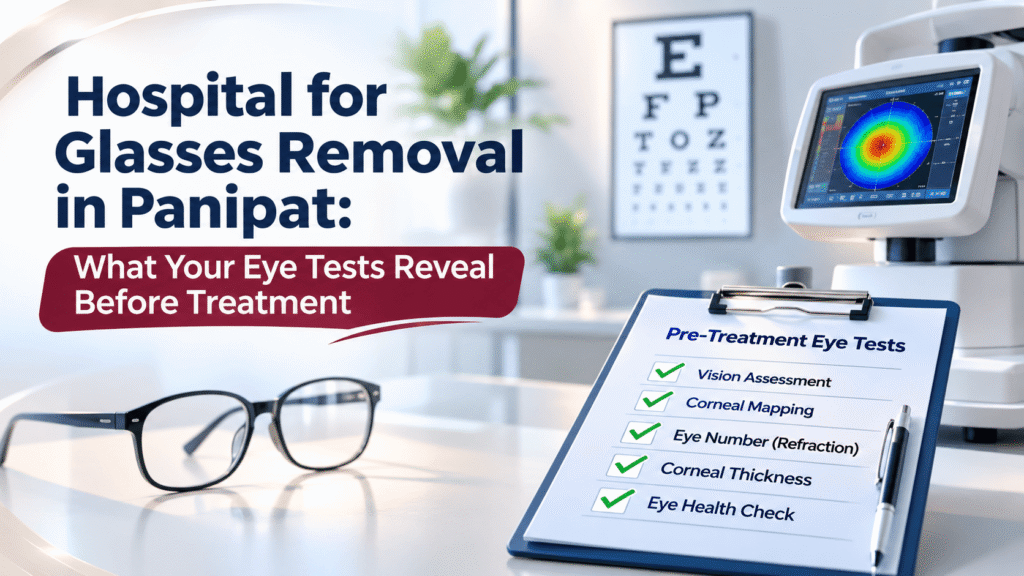
Thinking about reducing your dependence on glasses? The first useful question is not which laser is newest. It is whether your eyes are suitable for a refractive procedure at all. A good evaluation can reveal whether laser vision correction is appropriate, whether a non-laser option deserves discussion, or whether glasses remain the safer choice for now.
If you are searching for a hospital for glasses removal in Panipat, this guide explains the tests behind that decision, the meaning of common results, the questions to ask and the practical steps to take before choosing treatment. It is written for people with short-sightedness, long-sightedness or astigmatism who want an informed consultation rather than a promise of spectacle-free vision.
What does “glasses removal” actually mean?
The phrase “glasses removal” usually refers to refractive procedures intended to reduce reliance on spectacles or contact lenses. It does not literally remove an underlying eye disease. Glasses compensate for the way the eye focuses incoming light. In suitable candidates, refractive treatment changes the optical power of the eye so that light focuses more accurately on the retina.
Myopia (minus power) makes distant objects look blurred; hyperopia (plus power) may affect near or distance vision; and astigmatism can distort vision at several distances. A separate age-related change, presbyopia, usually becomes noticeable from the 40s and affects near focusing. These conditions do not all require the same solution. Your age, prescription, corneal measurements, occupation and expectations influence which choices are reasonable.
A successful consultation may lead to LASIK, a surface-laser technique, an implantable lens assessment or a recommendation not to operate. The responsible outcome is an appropriate decision, not surgery for everyone.
Why eligibility testing matters more than the procedure name
Two people may both wear −4.00 D glasses yet have very different treatment options. One may have a regular cornea and stable power. The other may have subtle corneal thinning, significant dry eye or a changing prescription. Treating them identically can introduce avoidable risk.
Refractive screening is therefore not merely a formality before booking surgery. It is the process of answering several clinical questions: Is the spectacle prescription accurate and stable? Is the cornea healthy and sufficiently thick? Is the ocular surface comfortable and stable? Is the retina healthy? Could another eye condition explain the blurred vision? And would the patient be satisfied if reading glasses or occasional distance correction were still needed?
A complete assessment also allows the ophthalmologist to identify warning signs that may alter the plan or rule out elective corneal laser treatment. Some risks, including persistent dry eye, glare, halos and under- or over-correction, need to be discussed before consent.
Seven checks worth understanding before glasses removal
1. Refraction and spectacle-power stability
Refraction measures the correction required for clear vision. The clinician may compare current readings with older prescriptions, repeat measurements and, when indicated, assess focusing under dilating drops. An unstable prescription is a reason to postpone elective refractive surgery and investigate why the power is changing. Many surgeons look for stability over about a year, although individual protocols vary.
Bring your last two spectacle prescriptions if available. Tell the doctor whether you recently changed power, whether one eye has changed more quickly, or whether vision fluctuates through the day. High prescription alone does not establish eligibility or ineligibility; it must be considered with the rest of the examination.
2. Corneal topography or tomography
Corneal imaging studies the shape of the clear front window of the eye. Topography maps the front surface; tomography may add information about the back surface and thickness distribution. These measurements help identify unusual curvature, asymmetry and patterns that may suggest keratoconus or corneal instability.
An irregular map does not automatically mean a person has a particular disease, but it needs expert interpretation. Someone with suspicious imaging may be advised against corneal laser surgery even if they can see well with glasses. This is one of the reasons a scan should not be reduced to a simple “pass” or “fail” without explanation.
3. Corneal thickness and predicted tissue remaining
Laser procedures reshape the cornea by removing tissue. The surgeon needs to know the original thickness, the planned treatment depth and whether the remaining corneal structure meets appropriate safety criteria. Thickness by itself is not a complete safety measure: the corneal shape, prescription and treatment design must be considered together.
Ask your surgeon to explain the imaging findings and why a proposed procedure is suitable for your particular cornea. A thin cornea or an unfavourable treatment calculation may shift the discussion toward other options, or toward continued spectacle use.
4. Tear film and dry-eye evaluation
Comfortable vision depends on a stable tear film. People who spend long hours using screens or wearing contact lenses may have burning, gritty sensation, watering or fluctuating blur. Dry eye can also occur without obvious symptoms. LASIK can worsen dry-eye problems, so ocular-surface assessment matters before treatment.
An examination may include eyelid and tear-film assessment and checks for inflammation. If a treatable problem is found, the ophthalmologist may recommend treatment and repeat measurements before making a surgical decision. A clearer corneal scan taken after the ocular surface improves may be more useful than rushing ahead with unstable measurements.
Read about the centre’s dry-eye service: https://bajajeyecentre.org/dry-eyes/
5. Pupil size and vision in dim light
Pupil behaviour and the planned optical treatment zone may be relevant to symptoms such as night glare, halos and starbursts. These symptoms can be especially important to people who drive at night. Modern planning accounts for multiple measurements, but no refractive procedure can promise perfect night vision.
Tell the doctor about existing difficulty with headlights, low-light driving or bright-light sensitivity. Understanding how you currently see in different lighting conditions helps set realistic expectations for the period after treatment.
6. Retina examination and overall eye health
A dilated eye examination may be advised to inspect the retina and other eye structures, particularly in people with higher myopia or concerning symptoms. A patient considering spectacle removal could also have retinal changes, cataract, glaucoma or inflammation that need separate attention. Refractive surgery does not treat these diseases.
New flashes, a sudden shower of floaters or a dark curtain across the vision warrant urgent eye evaluation rather than waiting for a routine laser consultation. A normal glasses prescription does not exclude retinal disease.
7. Age, health history and visual goals
Most laser refractive surgery assessments are intended for adults with stable prescriptions; being over 18 does not guarantee eligibility. Pregnancy, breastfeeding, certain medications, uncontrolled medical conditions and healing problems can affect timing or suitability. After the early 40s, presbyopia often changes near-vision needs, even in someone whose distance prescription was previously treated.
Explain what matters most in everyday life: distance driving, office screens, detailed near work, sports or reducing contact-lens wear. The surgeon can then discuss what treatment may realistically achieve, including the possibility that glasses will still be needed for some tasks.
Which glasses-removal options might be discussed in Panipat?
The correct procedure depends on the examination rather than the advertising label. Bajaj Eye Centre’s official refractive-surgery service page discusses LASIK, PRK or surface treatment, ICL/phakic intraocular lenses and refractive lens exchange as possibilities considered after screening. Availability and suitability of an individual option should be confirmed at the appointment.
LASIK and personalised laser approaches
LASIK changes corneal focusing power using laser treatment beneath a corneal flap. Suitable patients often recover functional vision relatively quickly, but complete healing and visual stability take longer. Topography-guided planning, such as Contoura Vision, uses corneal mapping to inform the treatment design. A more customised label does not overcome a contraindication, and no technique should be presented as universally appropriate.
Bajaj Eye Centre has information about its refractive-surgery services and laser technologies on its website. The examination should determine whether a corneal procedure is reasonable before patients compare specific laser platforms.
Read the official refractive-surgery and LASIK service page: https://bajajeyecentre.org/refractive-surgery-and-lasik/
Surface laser treatment, including PRK
Surface ablation reshapes the cornea without making a LASIK flap. Depending on the individual eye and treatment protocol, it may be discussed when a flap-based procedure is not preferred. Discomfort during early healing and a slower visual recovery than LASIK are important considerations. Surface laser is not automatically safe for every thin or irregular cornea; candidacy still requires full testing.
ICL or other lens-based approaches
An implantable collamer lens is placed inside the eye while leaving the natural lens in place. It may be considered for certain people with higher prescriptions or those who are unsuitable for corneal laser surgery, provided internal eye measurements and other eligibility conditions are met. It is intraocular surgery, with a different set of risks and follow-up requirements from laser correction.
Refractive lens exchange may sometimes be discussed in selected circumstances, often when age and lens-related considerations change the balance of options. It is not interchangeable with laser surgery, and its potential consequences, including loss of natural accommodation and retinal considerations in some patients, should be discussed carefully.
Can someone be unsuitable for LASIK but still have options?
Possibly, but the reason for LASIK ineligibility matters. A relatively thin but otherwise healthy cornea, a very high prescription, an abnormal topography scan and uncontrolled dry eye are not equivalent findings. Some patients may be assessed for a different operation; others should first treat an ocular condition or avoid elective surgery.
The safest approach is to ask the ophthalmologist to name the specific limiting factor and explain whether an alternative removes that concern or introduces a different one. Do not assume that a treatment described as “flapless” or “touchless” bypasses every risk associated with corneal surgery.
What happens during a glasses-removal consultation?
A useful visit begins with your symptoms and visual goals, followed by refraction, eye-health assessment and the investigations considered necessary. Some tests require dilating drops, so you may have temporary near blur and light sensitivity afterward. Ask the centre beforehand whether you should arrange transport.
Contact lenses can change corneal shape temporarily. Tell the clinic which lenses you wear and follow its instructions about when to stop wearing them before measurements; the interval may vary by lens type and eye condition. Bring your spectacles, earlier prescriptions, contact-lens details and a list of medicines or known eye conditions.
After testing, ask for a clear explanation of the recommended approach, alternatives, expected recovery, limitations, possible side effects, follow-up schedule and total estimated cost. You should have time to consider the information. A decision to defer surgery is a reasonable result of a careful assessment.
Questions to ask before you agree to treatment
Patients comparing a hospital for glasses removal in Panipat can use the consultation to ask: What do my corneal scans show? Has my prescription remained stable enough? Which findings make me suitable or unsuitable? What other options could meet my needs? What is my chance of still needing glasses for driving or reading? What could happen to night vision and dryness? What are the risks specific to my eye health? Who will provide postoperative care, and what should I do if symptoms occur after working hours?
Ask for a written estimate that distinguishes examination charges, procedure fees, medicines and follow-up costs. Insurance coverage for elective refractive procedures is often limited; do not assume cashless eye-care empanelment automatically covers glasses-removal surgery.
Recovery: plan for healing, not just the procedure day
Recovery varies by method and person. After LASIK, some patients notice improvement quickly, while dryness, fluctuating clarity or light sensitivity can continue for a period. Surface treatment generally has a longer early recovery. Lens-based procedures have their own restrictions and monitoring schedule. Your operating team should give instructions specific to the procedure performed.
Avoid rubbing the eyes, use prescribed medicines as directed and attend scheduled reviews. Ask when it is safe to resume driving, screens, sports, swimming and makeup rather than relying on a generic social-media timeline. Contact your care team promptly for increasing pain, marked redness or worsening vision; sudden severe symptoms require urgent assessment.
Why a local, follow-up-friendly choice matters
Surgery is only one part of refractive care. Measurements before treatment and access to reviews afterward are equally important. When selecting a hospital for glasses removal in Panipat, evaluate whether the clinic explains suitability clearly, answers questions without pressure, provides written postoperative instructions and makes it straightforward to seek advice if symptoms develop.
Bajaj Eye Centre is located at 206 New Sukhdev Nagar, Panipat, Haryana. Its official website lists refractive surgery/LASIK among its eye-care services. The centre’s published information can help you plan an assessment, while the treating ophthalmologist must confirm any recommended procedure following your individual tests.
Read a related article about the centre’s laser platform and techniques: https://bajajeyecentre.org/best-lasik-hospital-in-panipat-contoura-alcon-ex500/
Explore the centre’s existing LASIK safety discussion: https://bajajeyecentre.org/is-lasik-surgery-safe-best-lasik-hospital-in-panipat/
Frequently Asked Questions About Glasses Removal in Panipat
1. Can I book glasses-removal surgery based only on my spectacle power?
No. Power alone cannot show whether your cornea, tear film and overall eye health are suitable. An ophthalmologist must interpret refraction and other examination findings before recommending treatment.
2. Why might my LASIK scan need to be repeated?
Contact-lens wear, dry eye, inconsistent measurements or suspicious corneal findings can make repeat imaging appropriate. Your specialist should explain the reason and any preparation needed before a repeat scan.
3. If my glasses power is stable, am I automatically eligible?
No. Stable power is important but insufficient. Corneal shape, thickness, retinal health, dryness, medical history and expectations also influence eligibility.
4. Can glasses-removal surgery treat lazy eye?
Refractive surgery may correct an optical power in selected adults, but it does not directly cure amblyopia, commonly called lazy eye. The expected vision depends on the eye’s underlying visual potential.
5. Is a flapless procedure always safer for thin corneas?
No. A technique without a flap may be appropriate in some cases, but the planned tissue removal and the shape and stability of the cornea still matter. A specialist must review individual risks.
6. Will I need reading glasses after treatment if I am over 40?
Possibly. Presbyopia typically affects near focusing with age. Correcting distance power does not guarantee freedom from reading glasses. Discuss your distance and near-vision priorities before choosing a procedure.
7. Can I undergo refractive surgery if I have dry eyes?
Mild or treatable dry-eye disease may require management and reassessment first. Severe or uncontrolled dry eye can make LASIK unsuitable. Only an eye examination can determine the appropriate next step.
8. Does having high minus power mean I need ICL?
Not necessarily. ICL may be discussed in selected patients, but internal eye measurements, prescription, age and ocular health determine eligibility. High power alone does not establish the right treatment.
9. How long should I stop contact lenses before a LASIK evaluation?
The required break varies with the lens material, wearing pattern and corneal findings. Contact the clinic for personalised instructions rather than using one rule for every type of lens.
10. Where can I enquire about a glasses-removal assessment in Panipat?
Bajaj Eye Centre lists its address as 206 New Sukhdev Nagar, Panipat, Haryana. You can call 0180-2630777 or +91-82959-12777 to ask about appointments and assessment instructions.
Plan an eye assessment at Bajaj Eye Centre, Panipat
If you are considering reducing dependence on spectacles, start with an ophthalmic evaluation rather than choosing an operation from a promotional headline. Bajaj Eye Centre publishes information about refractive surgery and related eye-care services on its official website. Its clinical team can advise on the examinations required and whether you may be suitable for a particular treatment.
Address: Bajaj Eye Centre, 206 New Sukhdev Nagar, Panipat, Haryana, India. Phone: 0180-2630777 | +91-82959-12777. Website: https://bajajeyecentre.org/. Call ahead to confirm clinic timings, screening preparation and appointment availability.
Contact and appointment information: https://bajajeyecentre.org/contact/
The decision worth getting right
The goal of glasses-removal care is not simply to choose between LASIK, PRK and ICL. It is to understand the health of your eyes, weigh the benefit of less dependence on glasses against treatment risks, and choose a path that makes sense for your vision and lifestyle. For anyone researching a hospital for glasses removal in Panipat, detailed screening and a clear conversation with an ophthalmologist provide the foundation for that decision.