

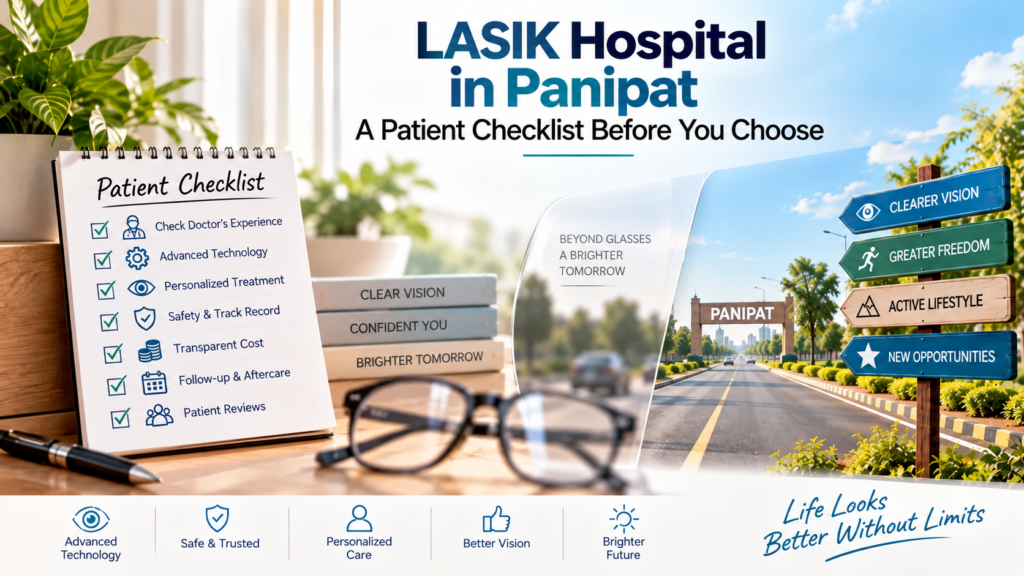
Searching for the LASIK hospital in Panipat usually begins with one goal: reducing dependence on glasses or contact lenses. However, choosing the right centre should involve more than comparing prices, advertisements or laser machine names.
LASIK is a medical procedure, and the safest choice depends on your eye health, corneal thickness, prescription stability, lifestyle and long-term visual needs. A reliable eye hospital should first determine whether LASIK is suitable for you and then explain all appropriate alternatives.
The right hospital should provide:
| What to check | Why it matters |
| Detailed eye examination | Confirms whether your eyes are suitable for refractive surgery |
| Qualified ophthalmologist | Ensures your treatment is planned and performed by an eye specialist |
| Appropriate technology | Helps match the procedure to your corneal shape and prescription |
| Alternative procedures | Provides options if LASIK is not suitable |
| Clear safety guidance | Helps you understand benefits, limitations and possible risks |
| Follow-up care | Allows your recovery and vision to be monitored properly |
Bajaj Eye Centre is one of the established eye-care centres in Panipat offering refractive surgery and LASIK services. Its published service information states that the centre began spectacle-removal surgery in Panipat in 2005 and has more than two decades of LASIK experience.
What does LASIK surgery do?
LASIK is a refractive eye procedure that reshapes the cornea so that light focuses more accurately on the retina. It may be used to correct common refractive errors such as:
- Myopia, or short-sightedness
- Hypermetropia, or long-sightedness
- Astigmatism
The main purpose of LASIK is to reduce dependence on spectacles or contact lenses. It does not guarantee that every patient will never need glasses again. Some people may still require glasses for specific activities, and age-related reading changes can occur naturally later in life.
The procedure selected for you should be based on your examination rather than on the popularity of a particular laser name. A good LASIK hospital will explain why a specific treatment is suitable for your eyes.
1. Begin with a complete suitability evaluation
The most important part of choosing a LASIK hospital is the quality of the pre-operative assessment.
A proper evaluation may include:
- Refraction and measurement of spectacle power
- Corneal mapping or topography
- Corneal thickness measurement
- Assessment of the tear film and dry-eye symptoms
- Examination of the retina
- Eye-pressure measurement
- Evaluation of pupil size, especially in dim light
- Review of previous eye conditions and surgeries
- Discussion of general medical history and medications
These tests help the ophthalmologist understand the structure and health of your eyes. They also help identify conditions that may make LASIK unsuitable or require further treatment before surgery.
Bajaj Eye Centre’s refractive surgery page explains that candidates generally need to be at least 18 years old, have stable spectacle power for at least six months and have healthy corneal and retinal examinations.
Refractive Surgery and LASIK: https://bajajeyecentre.org/refractive-surgery-and-lasik/
A screening scan should never be treated as a formality. It is the foundation of the treatment plan.
2. Check whether the surgeon explains your individual results
Two people with the same spectacle power may not be suitable for the same procedure. Corneal thickness, corneal shape, tear-film quality, pupil size and lifestyle can all influence the final recommendation.
During your consultation, the surgeon should explain:
- Your current spectacle power
- Whether your power is stable
- The thickness and shape of your cornea
- The health of your retina and optic nerve
- Whether you have dry-eye symptoms
- Which procedure is appropriate for your eyes
- What results are realistic
- What limitations or risks should be considered
The consultation should give you time to ask questions. You should not feel pressured to decide immediately.
A patient-centred LASIK hospital will discuss the reason behind the recommendation instead of simply promoting one procedure for everyone. The doctor should also explain what may happen if LASIK is not the right option.
You can review the hospital’s doctors here:
Bajaj Eye Centre doctors: https://bajajeyecentre.org/our-doctors/
3. Understand the available options for glasses removal
LASIK is one option for reducing dependence on glasses, but it is not the only one. Depending on your examination, an ophthalmologist may discuss procedures such as:
LASIK
LASIK reshapes the cornea to correct refractive error. It is commonly considered when the cornea is healthy, the power is stable and the overall eye examination is suitable.
PRK or touchless laser procedures
PRK may be considered for some patients whose corneal thickness, surface or lifestyle makes LASIK less suitable. Recovery can be different from LASIK, so the doctor should explain the expected healing period.
ICL or phakic IOL
An implantable collamer lens, also called a phakic IOL, is placed inside the eye without removing the natural lens. It may be discussed for selected patients with higher spectacle powers or for people who are not suitable for corneal laser surgery.
Refractive lens exchange
Refractive lens exchange involves replacing the natural lens with an artificial intraocular lens. It may be considered in selected cases, particularly when the natural lens or age-related vision needs are part of the clinical discussion.
No single procedure is for every patient. The LASIK hospital in Panipat should also be able to explain alternatives honestly when LASIK is not advisable.
4. Ask how technology will be matched to your eyes
Patients often search for terms such as Contoura, blade-free LASIK, Streamlight LASIK or advanced laser vision correction. Technology can be valuable, but the name of a machine alone does not determine whether treatment is appropriate.
Ask the hospital:
- Which laser platform will be used?
- Is the procedure customised to my corneal map?
- What diagnostic tests are used before treatment?
- Who will perform the procedure?
- What happens if my scan shows that LASIK is unsuitable?
- Are follow-up visits included in the treatment plan?
- What instructions will I receive after surgery?
Bajaj Eye Centre’s published refractive surgery information discusses blade-free LASIK, Contoura Vision and other refractive procedures. Patients should still understand that the final recommendation depends on the individual examination.
A useful technology discussion should connect the equipment to your eye measurements and treatment goals. It should not be limited to marketing terms.
5. Consider the surgeon’s qualifications and areas of expertise
The doctor’s experience and area of clinical expertise are important when selecting a LASIK centre.
Bajaj Eye Centre lists several ophthalmologists, including Dr R.K. Bajaj, Dr Vandana Bajaj, Dr Kenshuk Marwah and Dr Aastha Bajaj Marwah. The hospital’s website also provides individual doctor profiles.
Dr R.K. Bajaj’s profile lists expertise in micro-incision cataract surgery and refractive procedures, including LASIK laser treatment:
Dr R.K. Bajaj: https://bajajeyecentre.org/dr-rk-bajaj/
Dr Ashima Bajaj’s profile lists refractive procedures, retina, dry eye, keratoconus and cataract surgery among her areas of expertise. Her profile also mentions postgraduate training in medical retina from PGI Chandigarh:
Dr Ashima Bajaj: https://bajajeyecentre.org/dr-ashima-bajaj/
When you meet the surgeon, ask who will evaluate your eyes, who will perform the procedure and who will manage follow-up care. Clear communication about the treating doctor is an important part of informed consent.
6. Check the hospital’s safety and follow-up process
A LASIK procedure may be completed quickly, but the treatment journey includes assessment, preparation and follow-up.
Before booking, ask about:
- Pre-operative examination
- Sterilisation and operating-room protocols
- Medication instructions
- Transport after surgery
- First follow-up visit
- Follow-up schedule during recovery
- Emergency contact information
- Management of dryness, irritation or blurred vision
- Instructions for returning to work, driving and exercise
The U.S. Food and Drug Administration advises patients to have a baseline evaluation, discuss benefits and risks with the doctor, disclose medical conditions and medications, and understand their responsibilities before and after surgery. Read the patient guidance here: https://www.fda.gov/medical-devices/lasik/what-should-i-expect-during-and-after-surgery
Follow-up care matters because recovery is different for every patient. Your doctor may adjust drops, monitor the corneal surface or check how your vision is stabilising.
Who may not be suitable for LASIK?
Not everyone who wears glasses is a suitable candidate for LASIK. A doctor may recommend postponing or avoiding surgery in situations such as:
- Unstable spectacle power
- Pregnancy or breastfeeding
- Keratoconus or an irregular cornea
- Thin corneas
- Active eye infection or inflammation
- Significant dry-eye disease
- Certain retinal conditions
- Previous eye surgery requiring special evaluation
- Medical conditions that may affect healing
- Some autoimmune conditions
- Certain types of uncontrolled diabetes
- Regular participation in contact sports
The FDA also advises patients to discuss conditions such as glaucoma, uveitis, previous eye injuries, keratoconus and dry eye with their doctor before considering refractive surgery. More information is available here: https://www.fda.gov/medical-devices/lasik/when-lasik-not-me
Being advised against LASIK does not always mean that glasses are your only option. Depending on your examination, the doctor may discuss PRK, ICL or another alternative.
What happens during a LASIK consultation?
A typical consultation may follow these steps:
Medical and eye history
The doctor will ask about your eye health, previous surgeries, contact-lens use, allergies, medications and general medical conditions.
Vision assessment
Your spectacle power and visual acuity will be measured. If your prescription has changed recently, surgery may need to be postponed until the power becomes stable.
Corneal and retinal examination
The cornea is examined for thickness, shape and regularity. The retina and other internal eye structures are also assessed.
Discussion of expectations
Tell the doctor why you are considering glasses removal. Your occupation, sports, night driving, screen use and expectations can influence the discussion.
Treatment recommendation
The surgeon will explain whether LASIK, PRK, ICL or another option is more suitable. The recommendation should be based on your results.
Consent and preparation
If you are suitable and decide to proceed, the hospital will explain preparation, medicines, procedure-day instructions and follow-up.
How should you prepare for a LASIK evaluation?
Contact lenses can temporarily change the shape of the cornea and affect measurements. The break required depends on the type of lens you wear. Bajaj Eye Centre’s service page advises patients to remove contact lenses at least 5–7 days before a LASIK eligibility scan. Confirm the exact duration with the hospital when booking, especially if you wear toric, rigid gas-permeable or hard lenses.
You should also:
- Bring your current and previous spectacle prescriptions
- Tell the doctor about eye allergies or dryness
- Share details of previous eye treatment
- Inform the doctor about all medicines
- Avoid arriving in contact lenses if instructed otherwise
- Arrange transport if surgery is planned
- Ask whether someone should accompany you
- Keep time available for the complete examination
Do not stop prescribed medicines without speaking to your doctor.
What is LASIK recovery like?
Many patients experience temporary watering, mild irritation, light sensitivity or fluctuating vision immediately after treatment. Your surgeon will prescribe drops and provide protective instructions.
During the early recovery period:
- Do not rub or press your eyes
- Use prescribed eye drops exactly as instructed
- Wear the protective shield if advised
- Avoid swimming until your doctor permits it
- Avoid eye makeup for the period recommended
- Protect your eyes from dust and accidental injury
- Do not drive until your vision is clear and your doctor permits it
- Attend every scheduled follow-up visit
The time required to return to work varies according to your occupation, procedure and recovery. People working in dusty environments, driving professionally or participating in contact sports may need specific restrictions.
The FDA notes that patients should arrange transport after surgery because vision may be blurry and medicines used for relaxation can affect driving ability. Recovery instructions may vary between patients, so follow the treating surgeon’s advice.
Why consider Bajaj Eye Centre for LASIK in Panipat?
Patients searching for a LASIK hospital in Panipat may consider Bajaj Eye Centre because the centre provides dedicated refractive surgery services along with other ophthalmic departments.
According to its official website:
- The centre was founded in 1988 by Dr R.K. Bajaj and Dr Vandana Bajaj.
- Its refractive surgery page states that spectacle-removal surgery was started in Panipat in 2005.
- The hospital provides LASIK and other refractive surgery options.
- Its doctors include ophthalmologists with expertise in refractive procedures, retina, dry eye, keratoconus and cataract surgery.
- The centre is located at 206 New Sukhdev Nagar, Panipat.
- Consultation hours are listed as Monday to Saturday, 9 am to 7 pm.
- The listed contact numbers are 0180-2630777 and +91-82959-12777.
Patients can review the refractive surgery information before scheduling a consultation. The final treatment decision should always be made after a personal eye examination.
Frequently Asked Questions
1. What should I look for in the LASIK hospital in Panipat?
Look for a hospital that provides a complete suitability evaluation, qualified ophthalmologists, appropriate technology, clear information about risks and alternatives, transparent treatment planning and proper follow-up care. The lowest price or a popular machine name should not be the only deciding factor.
2. Is every person who wears glasses eligible for LASIK?
No. Eligibility depends on age, stable spectacle power, corneal thickness and shape, tear-film health, retinal health and general medical history. Some patients may be advised to consider PRK, ICL or another option instead.
3. How stable should my spectacle power be before LASIK?
Bajaj Eye Centre’s service information mentions stable spectacle power for at least six months. Your ophthalmologist will review your previous prescriptions and decide whether your power is stable enough for treatment.
4. How long should I stop wearing contact lenses before a LASIK scan?
The required interval depends on the type of contact lens. Bajaj Eye Centre advises removing lenses at least 5–7 days before a scan, while some lens types may require a longer break. Confirm the exact instruction with the clinic before your evaluation.
5. What tests are performed before LASIK?
The evaluation may include refraction, corneal mapping, corneal thickness measurement, dry-eye assessment, retinal examination, eye-pressure measurement and pupil assessment. The exact tests depend on your medical and eye history.
6. Is Contoura better than standard LASIK for everyone?
No procedure is automatically better for every patient. Contoura or another customised treatment may be considered when the examination supports it. Your surgeon should explain which option is appropriate for your corneal measurements and visual needs.
7. Does LASIK surgery hurt?
Numbing drops are used during the procedure, so most patients do not experience sharp pain during surgery. Temporary watering, irritation, light sensitivity or blurry vision may occur afterward. Follow your surgeon’s instructions and report severe or unexpected symptoms promptly.
8. How soon can I return to work after LASIK?
The timeline depends on the procedure, your occupation and your recovery. People with office-based work may return sooner than those exposed to dust, chemicals, heavy physical activity or contact sports. Your doctor will provide individual guidance.
9. Can LASIK correct high spectacle power or astigmatism?
LASIK may correct selected levels of myopia, hypermetropia and astigmatism, but suitability depends on the cornea and complete eye examination. Patients with higher powers may also be evaluated for options such as ICL.
10. What happens if I am not suitable for LASIK?
Your doctor may recommend waiting until your power stabilises, treating dry eye or another condition first, or considering an alternative such as PRK, ICL or refractive lens exchange. Not being suitable for LASIK does not automatically mean that no vision-correction option is available.
Book a LASIK consultation in Panipat
If you are considering glasses removal, begin with a detailed consultation instead of selecting a procedure only by its name. Bring your previous prescriptions, share your complete medical history and ask the surgeon to explain your suitability, treatment options, expected recovery and follow-up plan.
You can request an appointment here:
Book an appointment: https://bajajeyecentre.org/book-appointment/
For the centre’s address, phone numbers and visiting hours:
Contact Bajaj Eye Centre: https://bajajeyecentre.org/contact/
Bajaj Eye Centre is located at 206 New Sukhdev Nagar, Panipat. The listed phone numbers are 0180-2630777 and +91-82959-12777.
Conclusion
The LASIK hospital in Panipat is the one that evaluates your eyes carefully, recommends the right procedure for your anatomy and explains the complete treatment journey clearly. A responsible decision includes more than laser technology. It includes the surgeon’s assessment, diagnostic testing, safety protocols, honest discussion of alternatives and dependable follow-up.
If you are thinking about LASIK or another glasses-removal procedure, schedule an evaluation and make your decision after understanding your individual eye health.